
Most people who try journaling quit within two weeks. The reason is rarely a lack of discipline. It is usually a mismatch between the method and the person: someone who wants quick mental clarity buys an elaborate dotted notebook and ends up spending an hour drawing layouts, or someone who loves structure stares at a blank page and freezes. Learning how to start journaling is less about willpower and more about choosing the right format, setting a tiny daily target, and removing friction.
To start journaling, pick one simple method (such as a 5-minute daily log, gratitude list, or free writing), choose a consistent time tied to an existing habit, and commit to writing just a few lines per day for two weeks. Keep the notebook or app visible, ignore grammar and neatness, and use prompts when you feel stuck. Consistency matters far more than length or style.
- Start with a 5-minute, 3-sentence minimum so the habit survives busy days.
- Match the method to your goal: expressive writing for stress, bullet journaling for productivity, gratitude journaling for mood.
- Anchor journaling to an existing routine, like morning coffee or brushing your teeth at night.
- Paper and digital both work; choose the one you will actually open every day.
- Missing a day is normal. The rule is never miss two in a row.
Why Journaling Is Worth the Effort
Journaling has one of the stronger research bases of any everyday wellbeing habit. Psychologist James Pennebaker’s expressive writing studies, starting in the 1980s, found that people who wrote about emotionally significant experiences for 15 to 20 minutes over three or four consecutive days often reported improved mood and, in several studies, fewer doctor visits in the following months. Later research by Robert Emmons and Michael McCullough found that people who regularly recorded things they were grateful for tended to report higher wellbeing than comparison groups.
Beyond the studies, the practical benefits are easy to notice within a few weeks:
- Mental decluttering: Writing worries down moves them out of the loop of rumination and onto a page where you can examine them.
- Better decisions: Seeing your reasoning in writing exposes weak assumptions and patterns you repeat.
- A record of progress: Rereading entries from three months ago shows growth that is invisible day to day.
- Improved focus: A short planning entry in the morning sets clear priorities before email and notifications take over.
Journaling is not a replacement for professional mental health care. If writing about a topic consistently leaves you more distressed, that is a signal to talk with a therapist or counselor rather than push through alone.
7 Journaling Methods: Find the One That Fits You
There is no single correct way to journal. Below are seven proven methods, each suited to a different goal and personality.

1. The 5-Minute Daily Log
Write three short lines each day: what happened, how you felt, and one thing you want to remember. This is the best default for absolute beginners because it is almost impossible to fail. Many long-term journalers started here and expanded later.
2. Morning Pages
Popularized by Julia Cameron in The Artist’s Way (1992), morning pages are three handwritten pages of stream-of-consciousness writing done first thing in the morning. You do not reread them or edit them. The goal is to empty the mental noise so you can think clearly. It takes about 20 to 30 minutes, so it suits people with flexible mornings and creative goals.
3. Gratitude Journaling
List three to five specific things you are grateful for. Specificity matters: “the barista remembered my order and asked about my exam” beats “coffee.” This method takes two to three minutes and works well before bed.
4. Bullet Journaling
Created by designer Ryder Carroll, the Bullet Journal method combines a to-do list, calendar, and diary using short bullets and symbols (a dot for tasks, a circle for events, a dash for notes). It is ideal for people who want productivity and reflection in one place. Ignore the elaborate artistic spreads on social media; the original system is deliberately minimal.
5. Prompt-Based Journaling
Answer one question per day, such as “What drained my energy today, and what restored it?” Prompts remove blank-page anxiety and are excellent for people who say they never know what to write.
6. Expressive Writing
Based on Pennebaker’s research, this involves writing continuously for 15 to 20 minutes about a stressful or emotional experience, exploring both the facts and your deepest feelings. Use it in focused bursts (for example, four consecutive days) when processing something difficult, rather than as a daily habit.
7. One-Line-a-Day Journal
Write a single sentence every day, often in a five-year journal where each page holds the same date across five years. Over time you can compare what you were doing on the same day in different years. It is the lowest-effort format and surprisingly meaningful in the long run.
Comparison Table: Which Journaling Method Should You Choose?
| Method | Time per Day | Best For | Difficulty | Main Drawback |
|---|---|---|---|---|
| 5-Minute Daily Log | 3-5 min | Complete beginners | Very easy | Can feel shallow over time |
| Morning Pages | 20-30 min | Creatives, overthinkers | Moderate | Requires a protected morning slot |
| Gratitude Journal | 2-3 min | Mood and optimism | Very easy | Gets repetitive without specificity |
| Bullet Journal | 5-15 min | Productivity and planning | Moderate | Setup can become a distraction |
| Prompt-Based | 5-10 min | People who freeze at a blank page | Easy | Depends on good prompts |
| Expressive Writing | 15-20 min | Processing stress or major events | Emotionally demanding | Can feel heavy short-term |
| One-Line-a-Day | 1 min | Busy schedules, memory keeping | Easiest | Limited depth |
If you are unsure, start with the 5-minute daily log or a gratitude journal for two weeks. Once the habit is established, layer in a second method, such as weekly prompt-based reflection on Sundays.
How to Start Journaling: A Step-by-Step Plan
- Define your why in one sentence. Examples: “I want to worry less at night” or “I want to remember my kids’ childhood.” Your reason determines your method.
- Choose paper or digital. Handwriting slows you down and many people find it more reflective. Apps like Day One, Apple Journal, or a simple notes file are searchable and always in your pocket. Pick whichever you will open daily.
- Set a tiny minimum. Three sentences or five minutes. You can always write more, but the minimum is what you commit to on bad days.
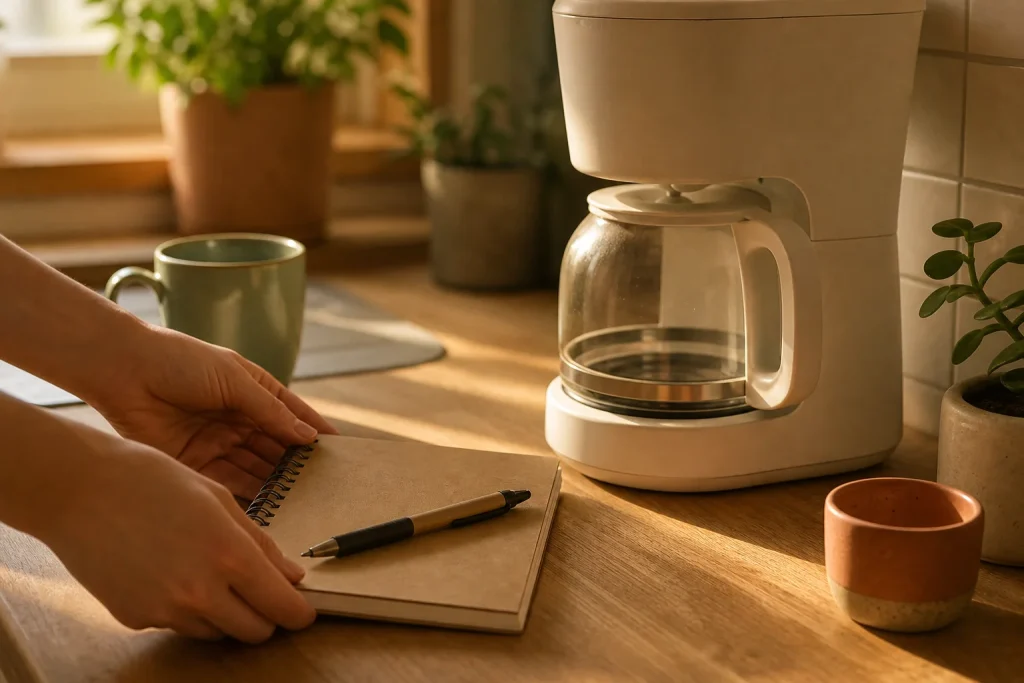
- Attach it to an anchor habit. Use habit stacking: “After I pour my morning coffee, I write three lines.” Existing routines act as reliable triggers.
- Make it visible. Leave the notebook open on your desk or nightstand, or put the app on your home screen. Friction kills new habits.
- Run a 14-day trial. Treat the first two weeks as an experiment, not a lifelong commitment. Track each day with a simple checkmark.
- Review weekly. Spend five minutes on Sunday rereading the week’s entries and noting one pattern or lesson. This is where journaling turns into insight.
30 Starter Prompts When You Don’t Know What to Write
Keep a short list of prompts on the inside cover of your journal or pinned in your app. A few that work well for beginners:
- What is taking up the most space in my head right now?
- What went better than expected today?
- What am I avoiding, and why?
- Who made my day easier, and how?
- What would make tomorrow 10% better?
- What did I learn this week that I want to keep?
- What am I tolerating that I could change?
- When did I feel most like myself today?
- What is one decision I keep postponing?
- What would I tell a friend in my situation?
Rotate through themes: reflection, gratitude, planning, relationships, and goals. Twenty more prompts can be generated by simply turning any frustration into a question: “Why did this bother me, and what does it say about what I value?”
Common Beginner Mistakes (and How to Fix Them)
Buying expensive supplies first
A beautiful notebook can create pressure to write “worthy” entries. Start with a cheap notebook or a free app. Upgrade once the habit has lasted a month.
Writing for an audience
If you edit sentences or worry someone might read it, your writing becomes performance. Keep the journal private and give yourself permission to be messy, repetitive, and even boring.
Only writing when upset
A journal filled exclusively with bad days paints a distorted picture of your life. Add at least one positive or neutral observation to each entry.
Setting the bar too high
Promising yourself 1,000 words a day leads to burnout. The 3-sentence minimum protects the streak while still allowing long entries on good days.
Quitting after a missed day
Breaks are inevitable. Adopt the “never miss twice” rule and simply pick up where you left off without trying to catch up on missed days.
Paper vs. Digital Journaling: Pros and Cons
Paper journals offer a screen-free, distraction-free experience and tend to encourage slower, more thoughtful writing. Downsides include no search function, limited portability, and the risk of loss. Digital journals are searchable, can be backed up, support photos and voice notes, and some include reminders and prompts. The trade-off is that your phone also contains every notification competing for your attention. A practical hybrid: paper for daily reflection at home, a phone notes app for capturing ideas on the go, merged during your weekly review.

How to Keep the Habit Going Long-Term
After the first month, most people need a little variety to stay engaged. Try these strategies:

- Monthly themes: Focus on one area per month, such as health in January or relationships in February.
- Quarterly rereads: Every three months, read back through entries and write a one-page summary of what changed.
- Combine methods: Daily one-liners on weekdays, longer reflective entries on weekends.
- Change locations: Writing at a cafe or park occasionally breaks routine fatigue.
- Track mood alongside entries: A simple 1 to 5 rating reveals connections between sleep, exercise, social time, and how you feel.
The people who journal for years usually describe it not as a chore but as a conversation with themselves. That shift happens only after the habit is automatic, which is why the early weeks should be kept deliberately easy.
Frequently Asked Questions (FAQs)
What is the best time of day to journal?
The best time is whenever you will do it consistently. Morning journaling is ideal for planning and clearing mental clutter, while evening journaling suits reflection and gratitude. Tie it to an existing routine for reliability.
How long should a journal entry be?
Beginners should aim for three sentences or five minutes. Research on expressive writing used 15 to 20 minute sessions, but for a daily habit, short and consistent beats long and occasional.
Is it better to journal by hand or on a computer?
Both are effective. Handwriting tends to feel slower and more reflective, while digital tools are faster, searchable, and easier to back up. Choose the format you will actually use every day.
What should I do if I miss several days?
Simply start again with today’s entry. Do not try to fill in missed days. Lower your minimum if you keep skipping, because frequent misses usually mean the target is too ambitious.
Final Thoughts
Knowing how to start journaling comes down to three choices: a method that matches your goal, a minimum small enough to survive busy days, and a trigger tied to something you already do. Pick one method from the table above, grab any notebook or app, and write three sentences today. Two weeks from now, you will have the start of a habit and a written record of how far you have come.