Nearly seven years after Hardwired… to Self-Destruct, Metallica returned in 2023 with an album that asked a surprisingly personal question: how much of who we are is decided before we turn eighteen? The answer became 72 Seasons, the band’s eleventh studio album and one of the most discussed releases of its late career. Here is what actually matters about the record.
Metallica 72 Seasons is the band’s 11th studio album, released on April 14, 2023, through Blackened Recordings. Produced by Greg Fidelman with James Hetfield and Lars Ulrich, it runs 12 tracks and about 77 minutes. The title refers to the first 18 years of life (18 × 4 seasons), which Hetfield says shape our adult identity.
- The title counts the 72 seasons of a person’s first 18 years, the core theme of Hetfield’s lyrics.
- Closing track “Inamorata” runs over 11 minutes, the longest song in Metallica’s studio catalog.
- The album topped charts in the UK, Germany and many other countries and debuted at No. 2 on the US Billboard 200.
- The title track won the Grammy for Best Metal Performance in 2024.
- The record launched the two-nights-per-city M72 era with a no-repeat setlist approach.
1. The Concept: What “72 Seasons” Actually Means
The title is simple arithmetic with heavy implications. Four seasons a year across eighteen years equals 72 seasons. When the album was announced on November 28, 2022, James Hetfield described those years as the period that forms our “true or false self” — the beliefs, fears and patterns installed by parents and environment that we either carry or fight for the rest of our lives.
For long-time listeners, this is familiar territory. Hetfield has written about family trauma, control and addiction since “Dyers Eve” and “Mama Said.” What changed on 72 Seasons is perspective. The lyrics are written by a man in his late fifties who had recently returned to rehab (in 2019), looking back with less rage and more analysis. Songs such as “Screaming Suicide” address mental health directly, while “Sleepwalk My Life Away” and “You Must Burn!” circle the idea of breaking inherited cycles.
The yellow-and-black artwork
The cover reinforces the theme: a burnt crib and charred childhood objects inside a room drenched in vivid yellow. The bright color became the visual identity of the entire campaign, from vinyl variants to stage design. It was a deliberate break from the dark, desaturated look of most metal releases, and it made the album instantly recognizable on streaming thumbnails and record-shop shelves.
2. How the Album Was Made
Much of 72 Seasons took shape during the COVID-19 lockdowns. With touring impossible, the band exchanged riffs and ideas remotely before reconvening at their HQ studio in San Rafael, California. Greg Fidelman, who engineered and mixed Death Magnetic and produced Hardwired, returned as producer alongside Hetfield and Ulrich.
That continuity matters. Fidelman’s approach favors a dry, punchy, live-sounding mix — a direct reaction against the heavily criticized loudness of Death Magnetic. On 72 Seasons, Robert Trujillo’s bass is clearly audible, Ulrich’s drums sound like a room rather than a sample, and Kirk Hammett’s solos were left loose and spontaneous.
The Hammett solo debate
Hammett’s leads became a talking point among fans. Some praised their raw, wah-heavy energy; others felt several sounded improvised rather than composed. Hammett has said in interviews that he prefers capturing first-take feel over over-polished perfection. Whichever side you take, it is a conscious creative choice, not an accident.
3. The Singles Rollout Was Unusually Long
Metallica released four tracks before the full album, spreading the campaign across almost five months:
- “Lux Æterna” (November 28, 2022) — a compact, NWOBHM-flavored speed burst under 3:30, recalling the Kill ‘Em All era.
- “Screaming Suicide” (January 2023) — a mid-tempo groove track tackling the stigma around suicide and mental health.
- “If Darkness Had a Son” (March 2023) — heavier and more stomping, with a chorus built for arenas.
- “72 Seasons” (the title track, released shortly before the album) — a seven-minute thrash opener that later won a Grammy.
Each single arrived with a music video, and “Lux Æterna” in particular reset expectations: many fans had assumed a 2020s Metallica record would be slow and sprawling, and the band answered with its most direct opener in decades.
4. “Inamorata”: Metallica’s Longest Song
The album closes with “Inamorata,” which runs roughly 11 minutes and 10 seconds. That makes it the longest track on any Metallica studio album, edging past “The Outlaw Torn” from Load (whose full unedited version appeared later, but the album cut is shorter) and the epics of the …And Justice for All era.
The title is Italian for “lover,” but the twist is that the lover is misery itself. Hetfield frames depression as a seductive partner that is hard to leave. Musically, the song moves from a doom-heavy main riff into a melodic, harmonized middle section with Hammett and Hetfield trading lines — a section many fans single out as the emotional peak of the album.
5. How 72 Seasons Compares to Recent Metallica Albums
Placing the record next to its two predecessors shows how the band’s late-career formula has evolved:
| Feature | Death Magnetic | Hardwired… to Self-Destruct | 72 Seasons |
|---|---|---|---|
| Release year | 2008 | 2016 | 2023 |
| Producer | Rick Rubin | Greg Fidelman, Hetfield, Ulrich | Greg Fidelman, Hetfield, Ulrich |
| Number of tracks | 10 | 12 (double album) | 12 (single long-player, 2 LPs on vinyl) |
| Approx. running time | 75 min | 77 min | 77 min |
| Longest song | “Suicide & Redemption” (~10:00) | “Halo on Fire” (~8:15) | “Inamorata” (~11:10) |
| US Billboard 200 peak | No. 1 | No. 1 | No. 2 |
| Sound reputation | Heavily compressed, controversial master | Clean, punchy, modern | Dry, live-feel, bass-forward |
| Main lyrical theme | Death and mortality | Self-destruction, technology, legacy | Childhood conditioning and identity |
The practical takeaway: if you liked the production of Hardwired, 72 Seasons sounds like its natural sibling, but with more consistent thematic focus and longer song structures.
6. Chart Performance and the 2024 Grammy
Commercially, 72 Seasons proved Metallica could still command a global release week. It reached No. 1 in the United Kingdom, Germany, and a long list of European markets, while debuting at No. 2 on the US Billboard 200, held off the top spot by Morgan Wallen’s blockbuster One Thing at a Time. The band also staged a global one-night cinema listening event on April 13, 2023, screening the album with its accompanying videos in theaters worldwide — an unusual move that turned an album launch into a fan event.
Critically, the reception was respectful rather than rapturous. Reviewers praised the energy and riff quality but frequently cited the length: 77 minutes with many songs over six minutes asks a lot of casual listeners. The industry, however, rewarded it. The title track “72 Seasons” won Best Metal Performance at the 66th Annual Grammy Awards in February 2024, adding to a Grammy shelf that already stretched back to the late 1980s.
7. The Album Built the M72 Era Around It
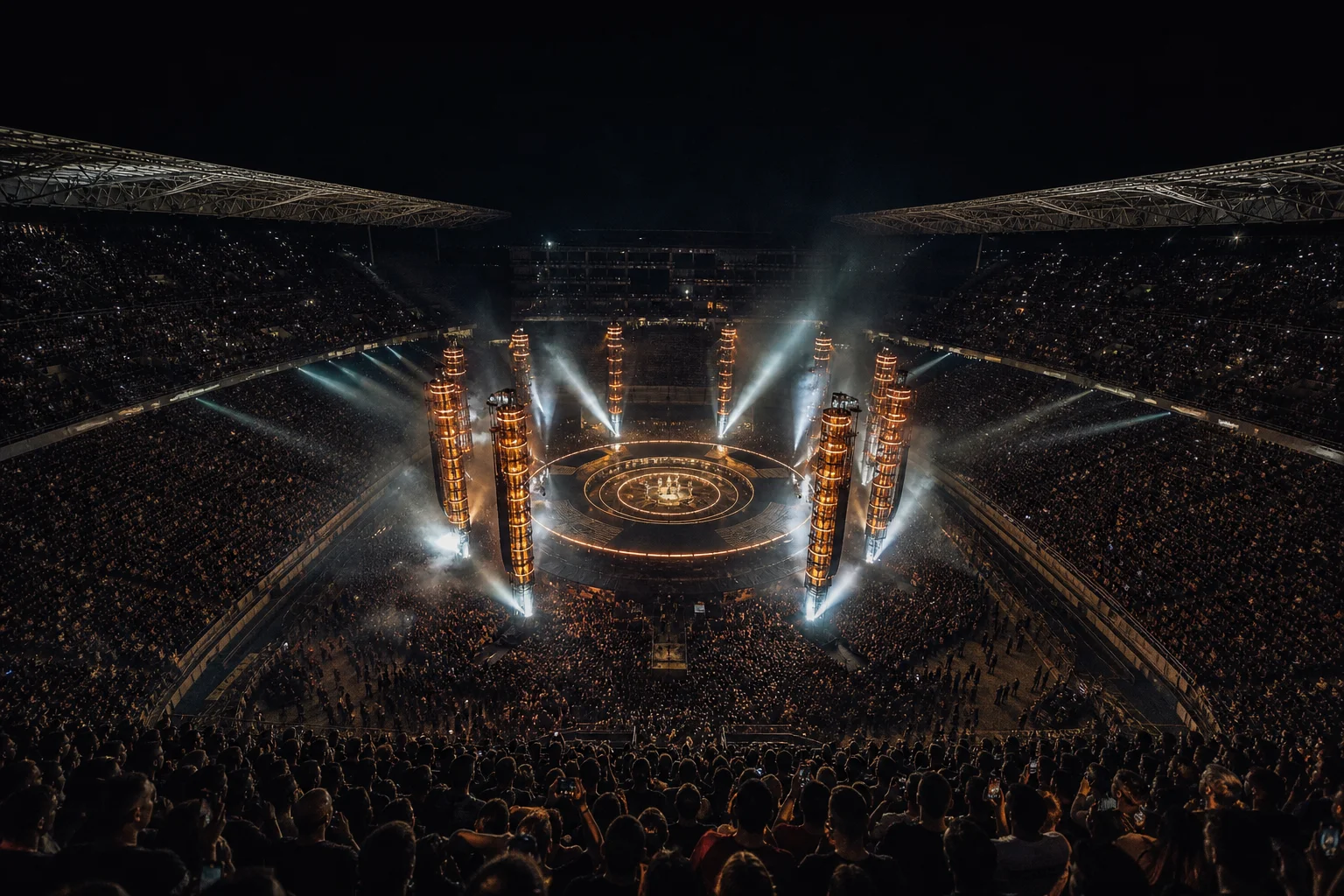
The record was conceived alongside its tour. The M72 World Tour adopted a “No Repeat Weekend” model: two shows per city with completely different setlists, plus an in-the-round stage with the famous “Snake Pit” in the center. Songs from 72 Seasons rotate heavily across both nights, which means the album has been played live far more consistently than most late-era material from rock legacy acts.
That is the real strategic point. Many veteran bands release new albums and then play one or two songs live. Metallica built its biggest production in years around the new record, giving tracks like “Lux Æterna,” “Screaming Suicide” and “If Darkness Had a Son” a real chance to become setlist staples.
Pros and cons for new listeners
- Pro: The strongest, most focused riff-writing since the early 2000s, with audible bass and organic drums.
- Pro: A coherent lyrical concept that rewards reading the lyrics.
- Pro: “Inamorata” is a genuine late-career epic.
- Con: At 77 minutes, the mid-album stretch can feel repetitive.
- Con: Guitar solos divide opinion — some find them raw, others underdeveloped.
Where to Start With 72 Seasons
If you are short on time, use this listening path: start with “Lux Æterna” for pure speed, move to “72 Seasons” for the thrash statement, then “Screaming Suicide” for the lyrical heart, and finish with “Inamorata” for the full emotional arc. Once those land, play the album front to back with the lyrics open — the concept makes far more sense as a complete narrative about conditioning, struggle and the attempt to break free.
For collectors, the album was issued on CD, cassette and a wide range of colored double-vinyl variants, with the yellow pressing becoming the signature edition. Check the Metallica Fan Club and official store for remaining stock rather than resellers.
FAQs
When was Metallica 72 Seasons released?
The album was released worldwide on April 14, 2023, through the band’s own label, Blackened Recordings. It was announced on November 28, 2022, alongside the single “Lux Æterna.”
Why is the album called 72 Seasons?
Eighteen years multiplied by four seasons equals 72. James Hetfield used the phrase to describe the formative childhood years that shape our personality, beliefs and emotional patterns as adults.
What is the longest song on 72 Seasons?
“Inamorata,” the closing track, runs about 11 minutes and 10 seconds. It is the longest song on any Metallica studio album.
Did 72 Seasons win a Grammy?
Yes. The title track “72 Seasons” won Best Metal Performance at the 66th Annual Grammy Awards in February 2024.