In 2013, Metallica tried something no heavy metal band had attempted at that scale: a self-financed, IMAX 3D feature that fused a full arena concert with a dialogue-light, apocalyptic short story. The result, Metallica Through the Never, divided critics, lost money at the box office, and still became one of the most technically ambitious concert films ever released. More than a decade later, it reads like a blueprint for how the band now treats live performance as cinema.
Direct answer: Metallica Through the Never is a 2013 3D concert film directed by Nimród Antal, combining live footage shot in Vancouver and Edmonton in August 2012 with a fictional story about a young roadie named Trip, played by Dane DeHaan. Metallica funded the roughly $18 million production themselves, and while it underperformed commercially, it is widely regarded as a visual landmark in concert filmmaking.
- The film blends a full Metallica arena set with a surreal narrative about a roadie sent on an urgent errand during the show.
- Metallica self-financed the project at a reported budget of around $18 million, keeping full creative control.
- Concert footage was captured over multiple nights at Rogers Arena (Vancouver) and Rexall Place (Edmonton) in 2012.
- The film grossed under $10 million worldwide, but its live double album performed strongly and its stage design became legendary.
- Its hybrid approach foreshadowed Metallica’s later cinema events and premium live streaming strategy.
1. It Was a Concert Film With a Story Running Through It
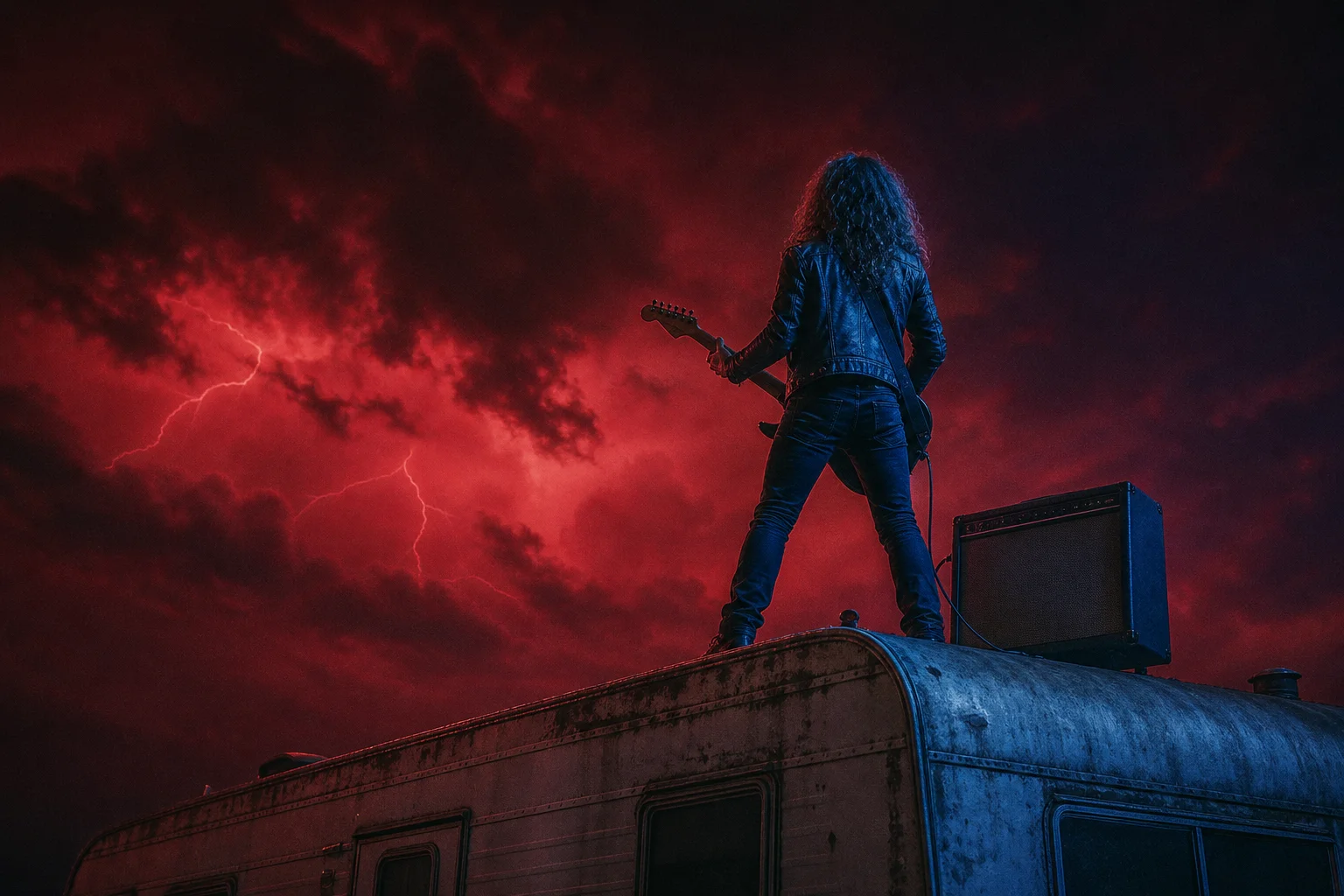
Most concert films follow a simple formula: cameras, crowd, songs, credits. Through the Never broke that formula by threading a fictional storyline through the performance. Dane DeHaan, then rising off Chronicle, plays Trip, a young Metallica crew member who is pulled away from the show and sent across the city to retrieve a mysterious bag the band urgently needs.
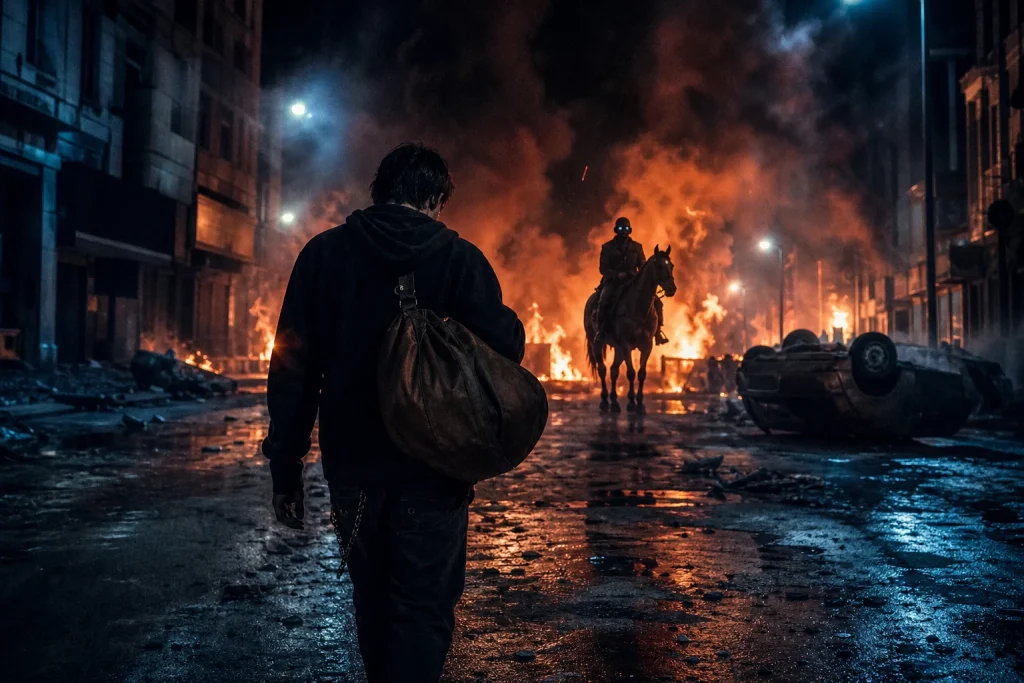
What follows is deliberately strange. Trip drives into a city collapsing into riots, encounters a masked horseman who hangs people from lampposts, and witnesses violent clashes between rioters and riot police. The narrative almost never explains itself. Director Nimród Antal, known for Kontroll and Predators, treated the story as a visual poem rather than a plot-driven thriller, mirroring the imagery and themes of the songs playing at the arena.
Why the narrative split audiences
- Supporters saw it as an extended music video that gave the concert emotional stakes and cinematic rhythm.
- Critics felt the story interrupted the music and never paid off, especially the famous unopened bag, which is never revealed.
- Hardcore fans largely came for the performance and accepted the story as atmospheric framing.
The ambiguous bag became a running joke and a fan theory magnet, with many comparing it to the briefcase in Pulp Fiction. That ambiguity was intentional: the band wanted viewers to fill in the meaning themselves.
2. Metallica Paid for It Themselves
One of the most important facts about Metallica Through the Never is that the band bankrolled it. The reported budget sat around $18 million, an enormous sum for a concert film. By self-financing, Metallica avoided studio interference and kept full ownership of the footage, the story, and the creative direction.
The trade-off was risk. When the film opened in IMAX on September 27, 2013, followed by a wider release in early October through distributor Picturehouse, it struggled to find an audience beyond the core fan base. Worldwide, it grossed under $10 million, meaning the band absorbed a significant loss on the theatrical run.
Lars Ulrich spoke openly in interviews about the financial hit, framing it as the cost of doing something unique. That candor matters: it shows a band that has historically controlled its own business, from master recordings to its own record label, Blackened Recordings, willing to gamble on an artistic statement.
3. The Concert Was Filmed Across Multiple Nights in Canada
The live footage was shot in August 2012 during a short run of Canadian dates: Rogers Arena in Vancouver and Rexall Place in Edmonton. Shooting across several nights allowed the crew to capture different angles, fix technical problems, and assemble the best performance of each song.
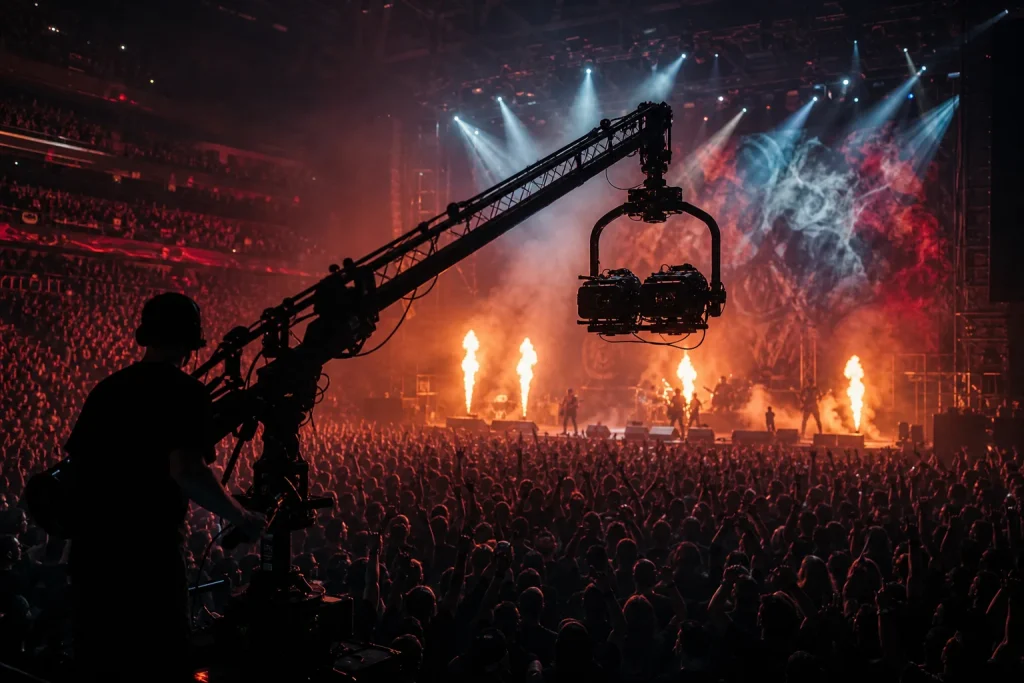
The production used 3D camera rigs positioned throughout the arena, including cranes, on-stage placements, and crowd-level vantage points. The goal was immersion: viewers should feel as though they were standing on the in-the-round stage with James Hetfield, Lars Ulrich, Kirk Hammett, and Robert Trujillo.
The setlist featured in the film
The film’s running order leaned heavily on the band’s 1980s catalog, balanced with a few later tracks:
- Creeping Death
- For Whom the Bell Tolls
- Fuel
- Ride the Lightning
- One
- The Memory Remains
- Wherever I May Roam
- Cyanide
- …And Justice for All
- Master of Puppets
- Battery
- Nothing Else Matters
- Enter Sandman
- Hit the Lights
- Orion (over the end credits)
The closing performance of the instrumental “Orion” in an empty arena is a quiet, poignant moment many fans read as a tribute to late bassist Cliff Burton, who co-wrote the track.
4. The Stage Was Built to Be Destroyed
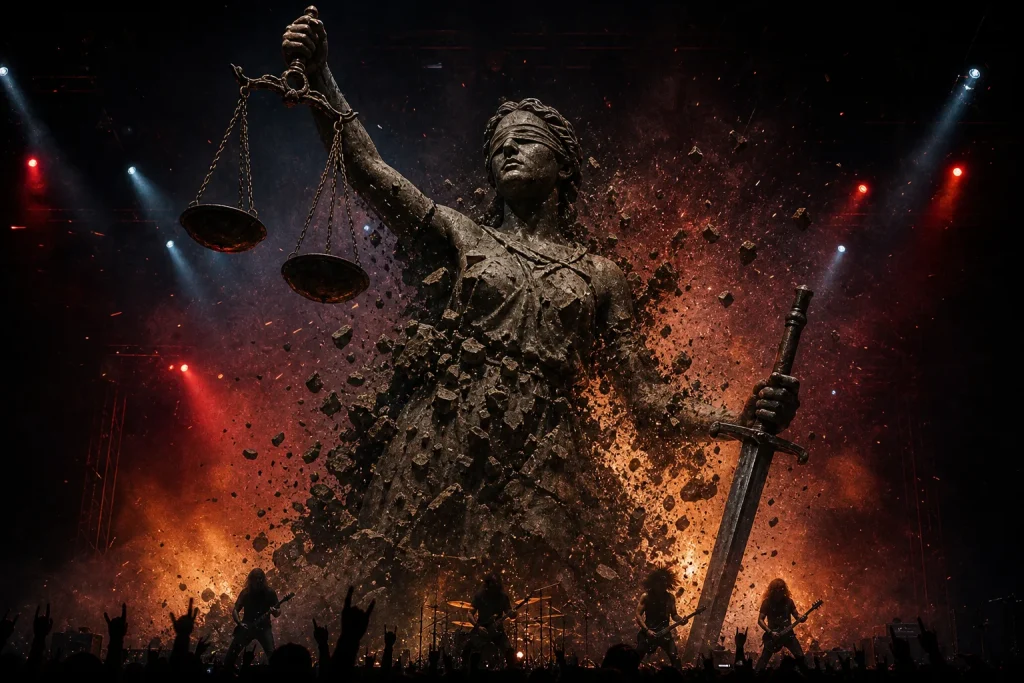
The stage design is arguably the film’s biggest star. Rather than reusing a standard tour rig, Metallica built a production specifically for the cameras, packed with set pieces tied to their most iconic album imagery.
| Stage Element | Song / Album Connection | What Happened On Screen |
|---|---|---|
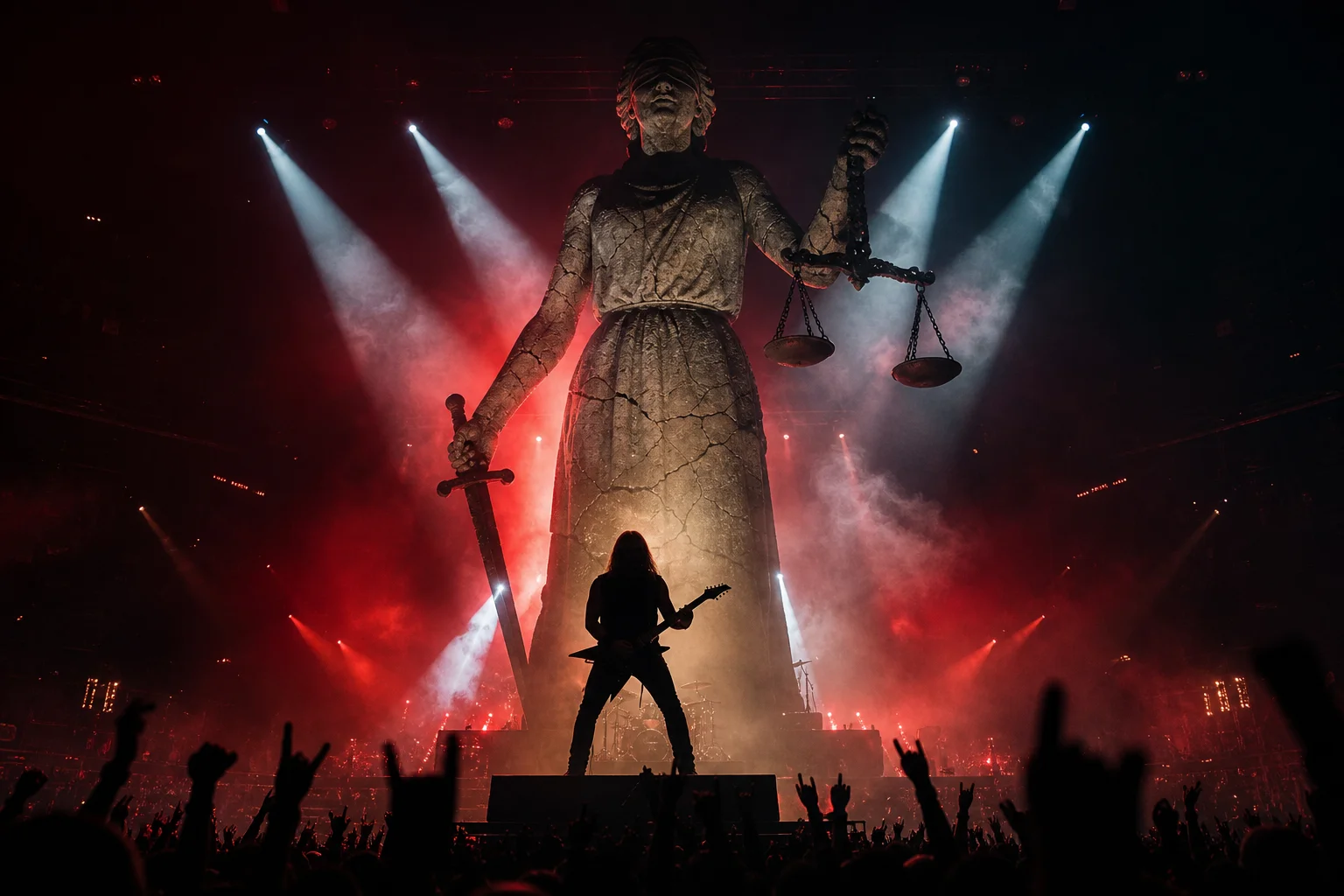
| Giant Lady Justice statue | …And Justice for All (1988) | Assembled on stage, then pulled apart and crashed down in a staged collapse |
| Tesla coils and electric chair imagery | Ride the Lightning (1984) | Arcing lightning bolts fired over the band during the title track |
| Rising coffins with video screens | Master of Puppets era imagery | Coffin-shaped LED boxes rose and lowered across the stage floor |
| Grave crosses on strings | Master of Puppets (1986) | White crosses lifted by wires, echoing the album cover |
| Staged equipment failure | …And Justice for All / Hit the Lights | Lights and rigging “collapsed,” forcing the band to play stripped-down with house lights |
| Laser and pyro effects | One, Enter Sandman | Battlefield explosions and searchlight sweeps over the audience |
The staged “disaster” sequence, where the rig appears to fail, the Justice statue topples, and crew rush onto the stage, ties the concert directly into Trip’s chaotic story outside. It is the moment where the two halves of the film finally converge, and it remains one of the most talked-about sequences in any metal concert film.
5. The Live Album Outperformed the Film
Alongside the movie, Metallica released a double live soundtrack album, Metallica Through the Never (Music from the Motion Picture), in September 2013 via Blackened Recordings. While the film struggled at the box office, the soundtrack did well, landing in the top ten of the Billboard 200 in the United States.
This split result is instructive. Fans clearly wanted the performance itself, the songs, the sound, the energy, more than they wanted a theatrical narrative experience. For collectors, the soundtrack remains one of the cleanest-sounding official Metallica live recordings from the Death Magnetic era, capturing the band in tight form before the long writing process that would lead to Hardwired… to Self-Destruct.
Film vs. soundtrack vs. later cinema events
| Release | Year | Format | Commercial Outcome | Main Appeal |
|---|---|---|---|---|
| Through the Never (film) | 2013 | IMAX 3D theatrical feature | Under $10M worldwide gross on ~$18M budget | Visual spectacle, hybrid narrative |
| Through the Never (soundtrack) | 2013 | Double live album | Top-ten debut on Billboard 200 | Polished live audio of a career-spanning set |
| M72 World Tour cinema broadcasts | 2023 | Live-to-cinema one-night events | Widely screened, event-based model | Shared live experience without a fixed narrative |
The lesson the band appears to have learned: audiences reward live-event authenticity. A decade later, Metallica leaned into one-night cinema broadcasts rather than scripted features.
6. Critics Praised the Visuals, Questioned the Story
Critical reception was mixed to positive, with a clear pattern. Reviewers almost universally praised the 3D cinematography, the sound mix, and the stage production. Many called it one of the best-looking concert films ever made, noting that the 3D actually served the experience instead of feeling like a gimmick.
The criticism focused on the narrative. Some reviewers felt Trip’s story was too thin to justify the screen time, while others argued it diluted the momentum of the concert. Dane DeHaan’s committed, nearly wordless performance was generally singled out as a strength even by skeptical critics.
The consensus, in short: the concert is a thrilling ride, and the story is either an inspired art-film experiment or a distraction, depending on why you bought a ticket.
For fans weighing whether to revisit it today, a practical tip: watch it on the largest screen and best sound system available. On a laptop, the film loses much of what made it special. On a large home theater setup with the 3D Blu-ray or a high-quality digital version, the stage production still impresses.
7. Its Legacy Shaped How Metallica Treats Live Shows
Although Through the Never is often described as a commercial misfire, its influence on Metallica’s approach to live content is easy to trace. Since 2013, the band has invested heavily in professionally captured live material: its LiveMetallica.com archive of soundboard recordings, high-production livestreams, drive-in concert screenings during 2021, and synchronized cinema broadcasts of the M72 World Tour.
The film also proved the band would take creative risks with its own money, something that echoes across their later decisions, from the in-the-round “Snake Pit” stage designs to experimental releases. It demonstrated that heavy metal could support high-concept cinematic presentation, opening doors for other rock acts to explore premium concert films and IMAX events.
Pros and cons for today’s viewer
- Pro: A career-spanning setlist performed with precision during a strong era for the lineup.
- Pro: Stage production that was never fully replicated on a regular tour.
- Pro: Excellent audio mix suitable for home theater systems.
- Con: The narrative is intentionally vague and may frustrate viewers wanting clear answers.
- Con: At around 93 minutes, the songs are interrupted by story cutaways more often than some fans prefer.
How to Watch Metallica Through the Never Today
The film was released on Blu-ray, 3D Blu-ray, and DVD in early 2014, and it has appeared on various digital rental and purchase platforms over the years. Availability on streaming services shifts by region, so check current listings in your country. Physical 3D Blu-ray copies remain the best way to experience the film as intended, provided you have compatible equipment. The soundtrack is widely available on streaming platforms and on vinyl, with original pressings becoming sought-after among collectors.
Frequently Asked Questions / FAQs
What is in the bag in Metallica Through the Never?
The film never reveals it. The contents of the bag are deliberately left unknown, and the band and director have treated it as an open question meant for audience interpretation.
Where was Metallica Through the Never filmed?
The concert portions were shot in August 2012 at Rogers Arena in Vancouver and Rexall Place in Edmonton, Canada. The narrative scenes were filmed separately with Dane DeHaan in the lead role.
Did Metallica Through the Never make money?
Not at the box office. The film reportedly cost around $18 million, which Metallica paid themselves, and it grossed under $10 million worldwide. The accompanying live album, however, sold well and reached the Billboard 200 top ten.
Is Metallica Through the Never worth watching for new fans?
Yes, especially for the performance. It offers a strong overview of classic songs like “Master of Puppets,” “One,” and “Enter Sandman,” played with a spectacular stage show. New fans who want music without interruptions may prefer the soundtrack album first.
Final Verdict
Metallica Through the Never remains one of the boldest swings in rock cinema: a self-funded, 3D, part-concert, part-surreal-thriller experiment from a band that could easily have played it safe. It did not conquer the box office, but it captured Metallica at a powerful moment, delivered a stage show fans still discuss, and helped shape the band’s modern relationship between live music and the big screen. If you have only seen clips, it is worth watching in full, ideally loud and on the biggest screen you can find.