On December 8, 2013, Metallica did something no major rock band had attempted: they played a full concert on the coldest, most remote continent on Earth. The show, branded Freeze ‘Em All, took place at an Argentine research base in front of a tiny audience wearing headphones, and it completed a world-record run that still sits uniquely in rock history. More than a decade later, the event remains one of the strangest and most fascinating chapters in the band’s career.
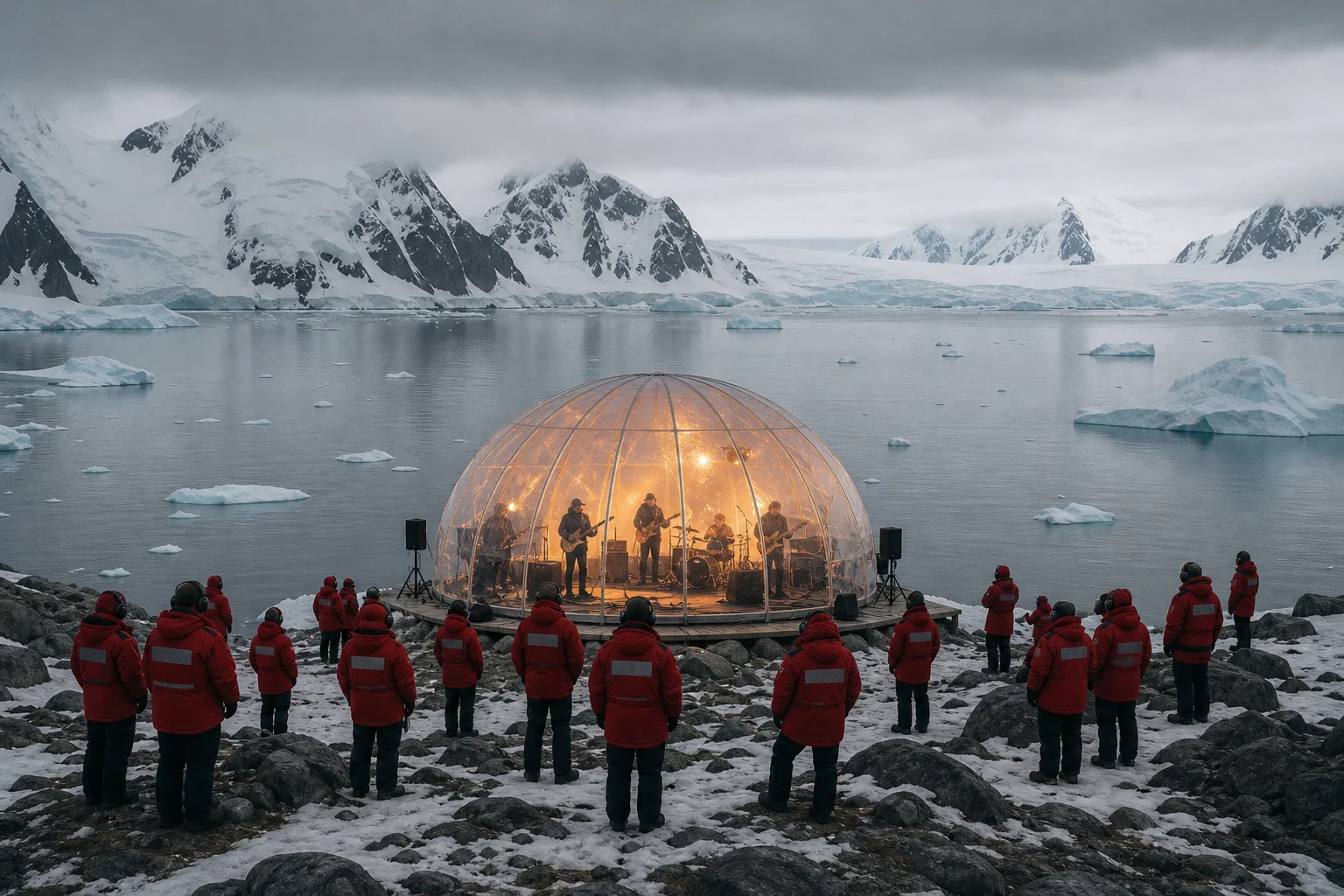
The Metallica Antarctica concert took place on December 8, 2013, at Carlini Station on King George Island, Antarctica. Metallica performed inside a transparent dome for roughly 120 contest winners and research scientists, who listened through headphones to protect the fragile environment. The show made Metallica the first band to play all seven continents within a single calendar year, earning a Guinness World Record.
- Date and place: December 8, 2013, at Carlini Station (an Argentine research base) on King George Island, part of the South Shetland Islands.
- The concert was a ‘silent’ show: amplifier output was isolated and fed to the audience through headphones to minimize noise impact on wildlife.
- About 120 people attended, mainly Latin American contest winners plus scientists and staff stationed in the region.
- The gig secured a Guinness World Record for the first act to perform on all seven continents in one calendar year.
- The event was promoted as Freeze ‘Em All, a play on the band’s 1983 debut Kill ‘Em All, and was backed by a soft-drink brand campaign.
Fact 1: Why Metallica Went to Antarctica at All
By 2013, Metallica had played almost everywhere a heavy metal band could reasonably tour. That year their schedule already stretched across North America, South America, Europe, Asia, Africa, and Oceania. Antarctica was the final blank square on the map, and once the logistics became possible, the record-setting angle made the trip almost irresistible.
The show was organized as a promotional campaign in partnership with a soft-drink brand, which ran a contest across Latin America. Winners earned a seat on an expedition voyage south, plus a spot inside the most exclusive venue Metallica has ever played. For the band, it was equal parts adventure, marketing event, and a chance to put a permanent flag in rock history.
The appeal was simple: no other band of Metallica’s stature had ever played a proper concert on Antarctica, and doing so in the same calendar year as shows on the other six continents turned a stunt into a measurable world record.
The name: Freeze ‘Em All
The title was a clever nod to Kill ‘Em All, the band’s 1983 debut. It instantly told fans what the event was and tied the frozen continent to the band’s thrash origins. The branding became shorthand for the whole expedition, and fans still use it when trading recordings and photos from the trip.
Fact 2: The Venue Was a Research Station, Not an Arena
The concert took place near Carlini Station (formerly known as Jubany), an Argentine scientific base on King George Island in the South Shetland Islands, just off the Antarctic Peninsula. This is one of the more accessible parts of Antarctica, which is exactly why it was chosen: ships departing from the southern tip of South America can reach the area in a matter of days, crossing the notoriously rough Drake Passage.
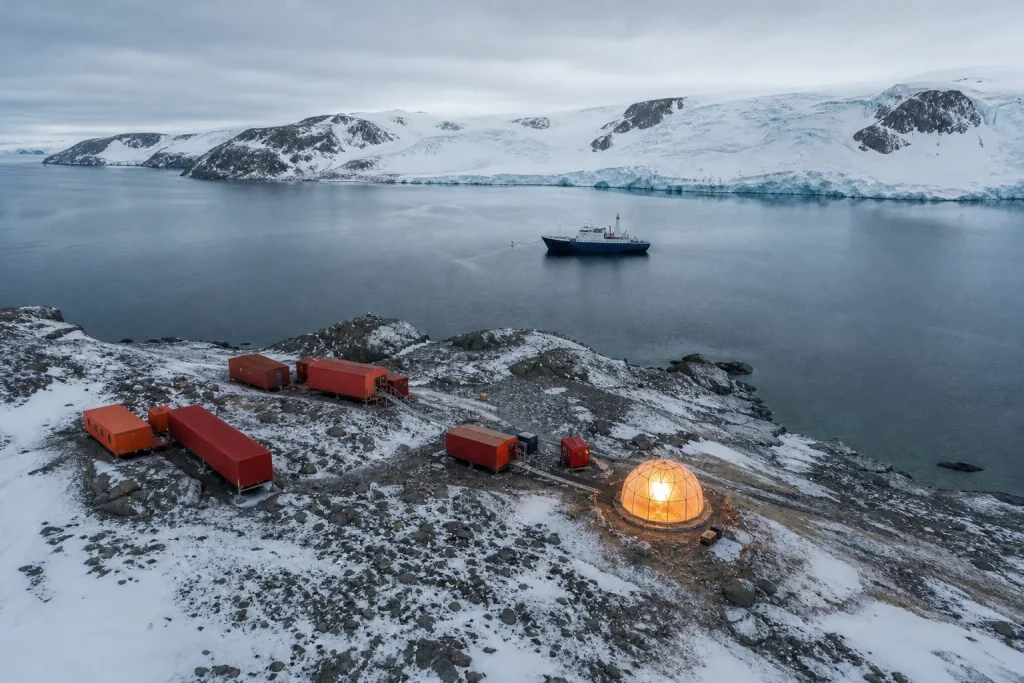
Instead of a stadium stage, the crew built a compact setup inside a transparent dome. The dome protected the band and gear from wind and cold while letting the audience see the surrounding Antarctic landscape. December falls in the southern summer, so temperatures were cold but manageable by Antarctic standards, and daylight lasts for most of the day at that latitude.
Fact 3: It Was a ‘Silent’ Headphone Concert
The most talked-about detail of the Metallica Antarctica concert is how it sounded, or rather, how little it sounded outside the dome. Antarctica operates under strict environmental protections through the Antarctic Treaty System, and large-scale noise is a real concern for wildlife and the ecosystem.
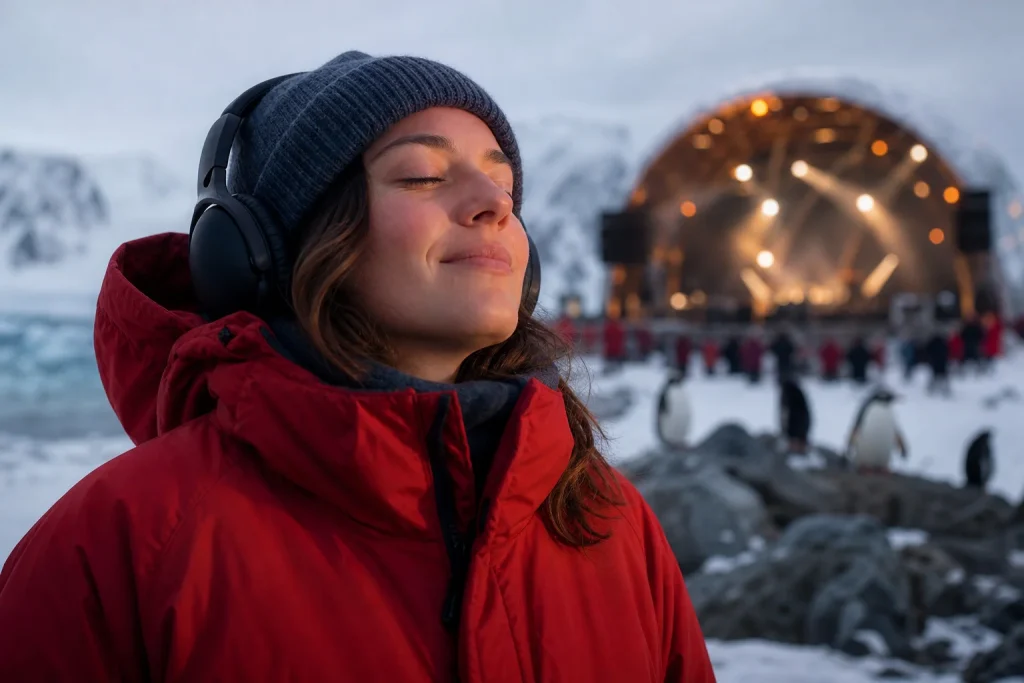
To respect that, the band’s amplifiers were isolated rather than blasting through a conventional PA. The audience received headphones and heard the mix directly, similar to a silent disco format. Lars Ulrich’s drums still produced acoustic sound inside the dome, but the overall noise footprint was a tiny fraction of a normal Metallica show.
What this meant for the audience experience
- Pristine mix: Fans heard a studio-quality blend of guitars, bass, and vocals directly in their ears.
- Unusual atmosphere: Without headphones, the room sounded surprisingly quiet apart from drums and crowd shouting.
- Intimacy: With roughly 120 people in attendance, every fan was effectively in the front rows.
For a band famous for overwhelming volume, the headphone approach was a striking reversal. It also became a reference point later for discussions about low-impact live events in sensitive environments.
Fact 4: Who Was Actually in the Crowd
The audience was among the smallest Metallica has played to as an established band. Estimates consistently put attendance at around 120 people. That group was made up of two main parts:
- Contest winners from across Latin America who earned their place through the promotional campaign.
- Scientists and support staff working at research stations in the area, for whom a Metallica show was an unexpected break from fieldwork.
Both groups traveled or gathered specifically for the event, and many winners later described it as the trip of a lifetime: an expedition cruise, penguin colonies, glaciers, and then a private Metallica concert at the end of the world.
Fact 5: The Setlist Was Short but Classic-Heavy
Freeze ‘Em All was not a marathon show. The band delivered a set of roughly ten songs lasting around an hour, focused heavily on fan favorites from their 1980s catalog and the Black Album era. Commonly reported songs from the night include:
- Creeping Death
- For Whom the Bell Tolls
- Sad but True
- Welcome Home (Sanitarium)
- Master of Puppets
- One
- Nothing Else Matters
- Enter Sandman
- Seek & Destroy
The choice made sense. With such a small, once-in-a-lifetime crowd, the band leaned on songs that everyone knew by heart. Seek & Destroy, a closing staple dating back to the earliest days, made a fitting finale for a show built around a Kill ‘Em All pun.
Fact 6: The Guinness World Record
The concert completed a remarkable year. In 2013, Metallica performed on every other continent, and the Antarctica show on December 8 closed the loop. Guinness World Records recognized the band as the first to perform on all seven continents within a single calendar year.

It is worth being precise here, because the record is often misquoted. The achievement is not simply ‘first band to play Antarctica’ in any form; it is specifically about covering all seven continents within one calendar year. That framing is what turned a promotional gig into a lasting entry in the record books and a staple of Metallica trivia.
How Freeze ‘Em All compares to a typical Metallica show
| Feature | Freeze ‘Em All (Antarctica, 2013) | Typical Metallica Stadium Show |
|---|---|---|
| Audience size | About 120 people | 40,000 to 80,000+ people |
| Venue | Transparent dome near a research station | Stadium or large arena |
| Sound delivery | Headphones, isolated amplifiers | Massive PA system |
| Set length | Around 10 songs, roughly 1 hour | Usually 16 to 20 songs, 2+ hours |
| How to get a ticket | Contest win or research station access | Public ticket sales |
| Travel required | Multi-day sea crossing via the Drake Passage | Local or regional travel |
| Environmental rules | Antarctic Treaty protections, minimal footprint | Standard local regulations |
| Historic significance | Guinness World Record (7 continents in 1 year) | Part of a regular tour cycle |
Fact 7: Its Legacy in Metallica History
Freeze ‘Em All has aged into more than a novelty. It captures several things that define Metallica as a live band: a willingness to try unusual formats, a global reach that few rock acts match, and a sense of humor about their own mythology.
The concert also fits a wider pattern of the band embracing experimental live projects. Their orchestral collaborations, festival curation with Orion Music + More, the concert film Metallica: Through the Never released in 2013, and later the in-the-round M72 staging all show a band that treats the live show as something to keep reinventing. Antarctica is the most extreme example of that mindset.
Pros and cons of the Antarctica approach
| Pros | Cons |
|---|---|
| Created a genuine world record and global headlines | Virtually no fans could attend |
| Low-impact headphone format respected the environment | Lost the physical power of a full PA experience |
| Unforgettable experience for winners and scientists | Expedition travel has its own carbon cost |
| Strong storytelling value for the band’s legacy | Tied to a commercial promotion, which some fans criticized |
Practical Takeaways for Fans Today
If you are a fan who missed Freeze ‘Em All, there are still ways to engage with this piece of history:
- Search for official footage: The band shared video and photos from the event through official channels. Start with Metallica’s own website and verified video accounts before relying on fan uploads.
- Check the band’s live archive: Metallica has made a habit of releasing soundboard recordings of shows through its LiveMetallica platform. Browse their catalog for any material connected to the 2013 run.
- Visit Antarctica yourself: Expedition cruises to the Antarctic Peninsula and South Shetland Islands typically depart from Ushuaia, Argentina, or fly-cruise options from Punta Arenas, Chile. The southern summer season (roughly November to March) is when visits happen. You will not catch a concert, but you can see the same landscapes.
- Learn the record correctly: When sharing trivia, remember the wording: first band to play all seven continents in a single calendar year.
Why the Story Still Resonates
Many rock stunts fade within a news cycle. The Metallica Antarctica concert endures because it combines a clear, verifiable achievement with an image that is impossible to forget: one of the loudest bands in the world playing quietly, inside a bubble, at the bottom of the planet. It reflects a band that had already conquered stadiums and decided the next challenge was geography itself.
For newer fans discovering Metallica, Freeze ‘Em All is a reminder that the band’s story is not only about albums and lineup changes. It is also about how far a group of musicians from the early 1980s Bay Area thrash scene would go to bring their music to every corner of the globe, literally.
Câu hỏi thường gặp / FAQs
When and where did Metallica play in Antarctica?
Metallica played on December 8, 2013, near Carlini Station, an Argentine research base on King George Island in the South Shetland Islands, off the Antarctic Peninsula.
How many people attended the Antarctica concert?
Around 120 people attended, made up mostly of Latin American contest winners and scientists or staff from research stations in the region.
Why did the audience wear headphones?
To minimize noise impact on Antarctica’s protected environment and wildlife, the band’s amplifiers were isolated and the mix was delivered through headphones instead of a large PA system.
What record did Metallica set with Freeze ‘Em All?
Guinness World Records recognized Metallica as the first band to perform on all seven continents within a single calendar year, completed with the Antarctica show in 2013.