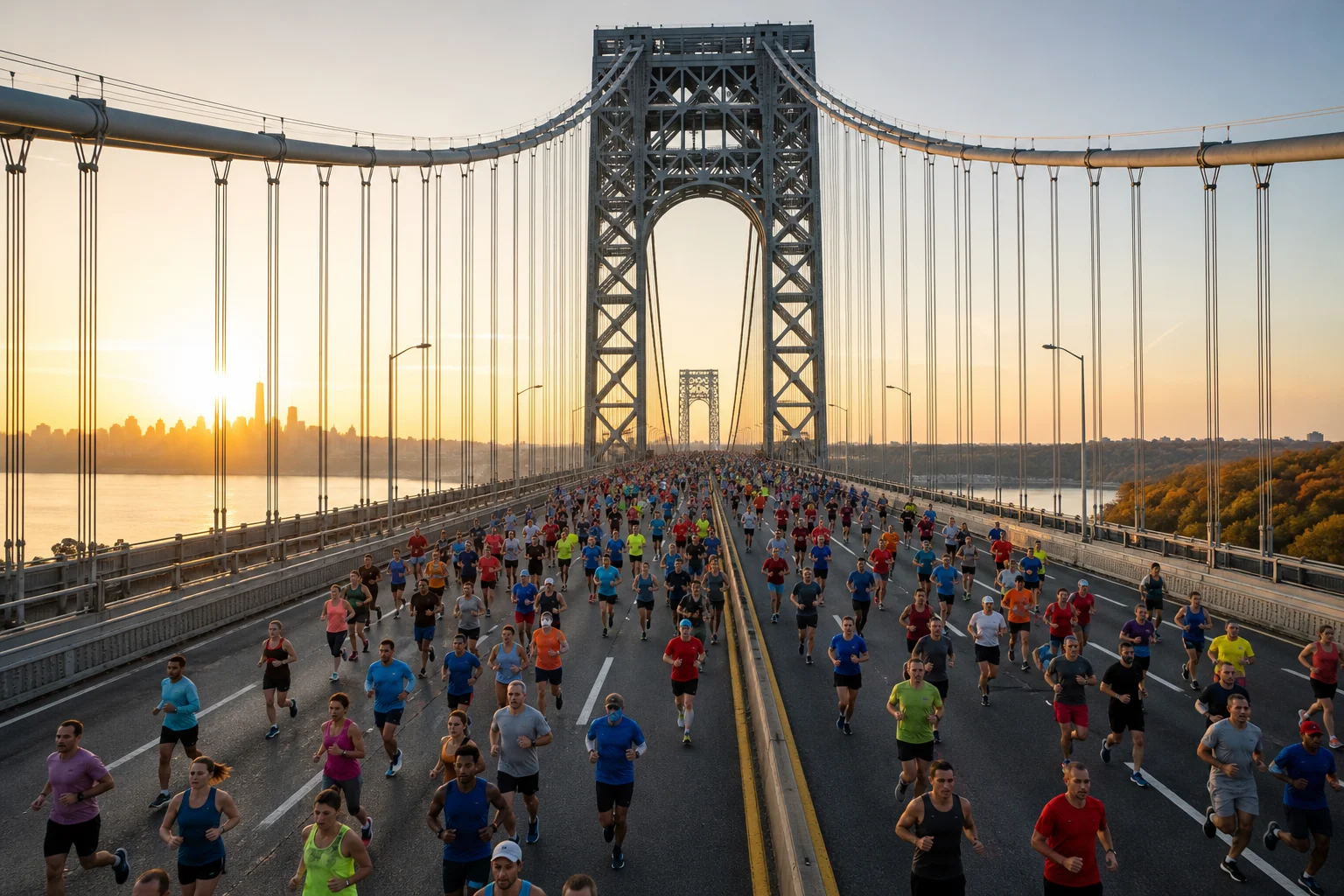
The NYC Marathon 2026 is more than a race. For one Sunday each November, New York’s five boroughs become a single 26.2-mile course. This year carries extra weight because it marks the 50th anniversary of the five-borough route. This guide covers the course, the start villages, the Expo, entry costs, fluids, the finish, and how spectators get around. Facts below are current as of October 29, 2026.
Quick answer: The 2026 TCS New York City Marathon takes place on Sunday, November 1, 2026, according to organizer New York Road Runners (NYRR). Start times are staggered from about 8:00 a.m. for wheelchair athletes to about 11:30 a.m. for the last wave. Runners start at Fort Wadsworth on Staten Island, cross five bridges through all five boroughs, and finish in Central Park.
- Race date: Sunday, November 1, 2026. NYRR lists an 8:00 AM start, and waves run until about 11:30 a.m.
- The 2025 race had 59,226 finishers from 132 countries, a world record for the largest marathon (MarathonGuide.com).
- The course crosses five bridges: Verrazzano-Narrows, Pulaski, Queensboro, Willis Avenue and Madison Avenue.
- The 2026 lottery is closed. Remaining routes in are Official Charity Partners or, for non-U.S. residents, Official International Tour Operators.
- Bibs are picked up at the Expo at the Javits Center in the days before the race. Bring ID and plan for crowds.
NYC Marathon 2026 at a Glance: What’s Confirmed
There is a lot of noise online about this race, so it helps to separate confirmed facts from speculation. Here is what reliable sources say as of late October 2026.
- Date and time: NYRR’s official event page lists the race for Sunday, November 1, 2026, at 8:00 AM in New York City.
- Record size: NYRR states the TCS New York City Marathon has broken the world record for the largest marathon two years in a row.
- 2025 numbers: MarathonGuide.com reports 59,226 finishers in 2025 from 132 countries. It also cites roughly 2 million spectators along the route.
- Course records (per MarathonGuide.com): Tamirat Tola holds the men’s record of 2:04:58, set in 2023. Hellen Obiri holds the women’s record of 2:19:51, set in 2025. Confirm both on nyrr.org before quoting them.
Not yet confirmed in our research: the 2026 field size, the elite start list, prize money, and the race-day forecast. Treat any specific figures you see for these as unverified until NYRR or the National Weather Service (weather.gov) publishes them.
A Brief History: From Central Park Loops to Five Boroughs
FatMarathoner notes that the race began in 1970 with 127 runners looping Central Park, and entry cost $1. The move to a course through all five boroughs made the race a citywide event. That is why 2026 is billed as the 50th anniversary of the five-borough route. Expect commemorative merchandise, anniversary branding at the Expo, and plenty of nostalgia coverage during race week.
The Five-Borough Course, Mile by Mile
The course is famous for its neighborhoods and crowds. The bridges and the late hills are what actually shape race strategy. NYRR publishes an interactive Google Map of the route on its website. Use it to pick spectator spots and to study the elevation before race day.
| Segment | Borough | Key Feature | Runner Tip |
|---|---|---|---|
| Start to ~Mile 2 | Staten Island to Brooklyn | Verrazzano-Narrows Bridge, the course’s longest climb | Hold back. The first mile is uphill and crowded, so going out fast wastes energy. |
| ~Miles 2–13 | Brooklyn | Long, flat-to-rolling stretch with loud crowds on Fourth Avenue and through Williamsburg | Settle into goal pace and keep the crowd energy from pushing you faster. |
| ~Mile 13 | Brooklyn to Queens | Pulaski Bridge, close to the halfway mark | Check your halfway split honestly. |
| ~Miles 15–16 | Queens to Manhattan | Queensboro Bridge, a long, quiet climb with no spectators | Run by effort, not pace. The roar on First Avenue comes right after. |
| ~Miles 16–20 | Manhattan (First Avenue) | Wide avenue with huge crowds | Don’t surge here. Many runners pay for it later. |
| ~Mile 20 | Manhattan to the Bronx | Willis Avenue Bridge | This is the classic “wall” zone, so fuel before you reach it. |
| ~Mile 21 | Bronx to Manhattan | Madison Avenue Bridge | This is the last bridge. Prepare mentally for Fifth Avenue. |
| ~Miles 22–26.2 | Manhattan | Gradual Fifth Avenue climb, then Central Park and the finish | Save something for the rollers in the park. |
Why the Bridges Matter
The bridges are exposed. FatMarathoner notes that early November conditions are often windy on the spans. Bridges can also confuse GPS watches, especially the lower deck of the Verrazzano and the Queensboro. Many experienced New York runners set a manual lap at each mile marker instead of trusting auto-splits.
Race Week and the TCS NYC Marathon Expo Presented by New Balance
The race-week schedule centers on the Expo at the Javits Center on Manhattan’s West Side. According to the5krunner, this is where participants collect their bibs in late October. Check your NYRR account for your assigned pickup window and the required documents. Generally that means photo ID plus the confirmation NYRR sends you.
Smart Expo Strategy
- Go early in the week. Crowds and lines usually grow as the weekend gets closer.
- Pick up your bib first, then shop. Official anniversary gear from New Balance may sell out in popular sizes.
- Don’t test new shoes or gels on race day. Buy them if you want, but save them for your next training block.
- Limit time on your feet. Walking a convention hall for hours two days before a marathon is a common, avoidable mistake.
Race week also usually includes shakeout runs and community events. NYRR posts the current schedule on its site and app. Those events are optional. Sleep, hydration and carbohydrates matter far more.
Race Day Information: Staging and Start Villages
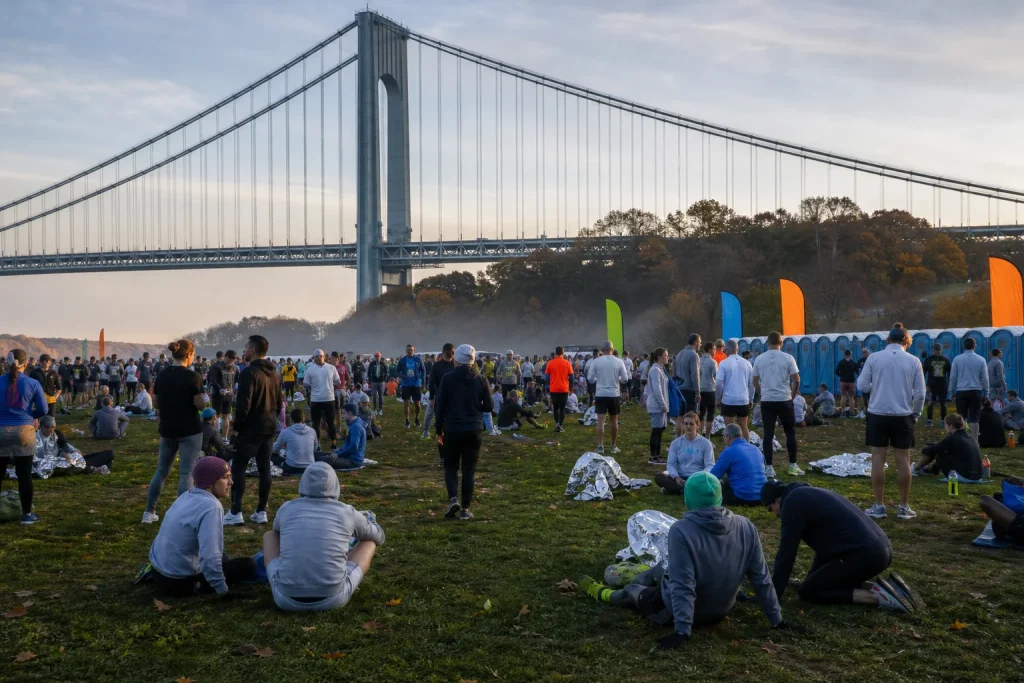
Race day starts hours before the gun. Runners are assigned a start village at Fort Wadsworth, the staging area at the foot of the Verrazzano-Narrows Bridge. Each village is color-coded, and your bib shows your village, wave and corral. Waves are staggered from about 8:00 a.m. (wheelchair division) to about 11:30 a.m. for the final wave, according to MarathonGuide.com.
Getting to the Start
Participants typically reach Staten Island by NYRR-coordinated transportation. In past years that meant the Staten Island Ferry from Lower Manhattan or chartered buses from designated pickup points. You choose your transport and time slot in advance. Treat that slot as fixed. Missing it can mean missing your wave.
What to Bring Into the Village
- Throwaway layers: Mornings on Staten Island can be cold and windy. Old sweatshirts left at the start are traditionally collected and donated.
- Something to sit on: A cheap poncho or foil blanket keeps you off cold, damp ground during a long wait.
- Pre-race fuel: Pack a familiar breakfast or snack. Villages generally offer basics like water, coffee and bagels, but don’t rely on finding your usual foods.
- Clear, approved bags only: Security rules are strict. Read NYRR’s current policy before packing.
Fluids, Food and Amenities on the Course
NYRR stations water and sports drink along the route. Historically these come roughly every mile from the early miles onward, with energy gels handed out at designated points in the later miles. Medical tents, portable toilets and mile markers run the full course. Check the official course map for the 2026 locations. Some runners also carry their own fuel so they don’t depend on a specific gel flavor.
Fueling Mistakes to Avoid
- Grabbing from the first table: The first tables at each station get mobbed. Volunteers usually staff both sides of the road and tables farther down, so move past the crowd.
- Drinking at every stop by default: Overdrinking is a real risk. Drink to thirst and stick to your training plan.
- Skipping fuel before the Queensboro: The bridge is quiet and hard, and many runners fade on First Avenue because they under-fueled in Queens.
Finish Line, Official Finishers and Sweep Buses
The finish is in Central Park, near Tavern on the Green. After crossing, runners walk through a recovery area where they receive medals and post-race supplies. Runners who chose the no-baggage option usually get a recovery poncho. Those who checked a bag collect it at their assigned area. The walk out of the park can feel long on tired legs, so plan your family meeting point before the race.
Official finishers are runners who complete the course within the official timing and course-closure rules NYRR publishes. A sweep bus follows behind the last pace on course. Participants who can’t keep pace may be offered a ride or asked to move to sidewalks once roads reopen. If you expect a longer finishing time, read the current course-closure and sweep guidance on nyrr.org. It decides whether you finish on a closed course or on reopened streets.
Entry, Fees and the Road to the 2026 Start Line
Many readers searching for nyc marathon 2026 want to know whether they can still get in. According to The Running Channel, the 2026 lottery application window ran from February 4 to February 25, and the drawing took place on March 4. NYRR confirms the drawing is complete. For 2026, the remaining routes are Official Charity Partners. Non-U.S. residents can also book a package with guaranteed entry through an Official International Tour Operator.
| Entry Route | Status for 2026 | Reported Cost | Source |
|---|---|---|---|
| Public lottery | Closed (drawing held March 4) | Entry fee if selected (see below) | The Running Channel / NYRR |
| Team for Kids (NYRR charity) | Registration opened October 2025 | $3,000 minimum fundraising plus entry fee | Legit.ng |
| Other charity partners | Varies by charity | $3,000 (Bronze) to $3,500 (Silver) minimums reported | MarathonBallot.com |
| International tour operator | Non-U.S. residents only | Package pricing varies | NYRR |
| 9+1 program | New pass fee introduced | $99 9+1 Pass, separate from membership and entry fees | FatMarathoner |
A note on entry fees: Published figures don’t match. Some guides list $269.66 for NYRR members and $333.11 for non-members. Others list base fees of $255 for members, $315 for non-member U.S. residents and $358 for non-U.S. residents, and one adds an $11 processing fee. The gap likely comes from processing fees. Check the exact breakdown on nyrr.org. Every source agrees that fees are non-refundable and non-transferable.
Spectator Guide: Road Closures, Transit and Viewing Spots
With roughly 2 million spectators (per MarathonGuide.com), getting around is the main challenge for supporters. Specific 2026 road and bridge closures and transit changes are published by the city and NYRR during race week. Our research could not verify the exact list, so check NYC DOT, MTA and NYRR updates on race morning.
Practical Spectator Tips
- Use the subway, not cars. Large parts of the route are closed to traffic for much of the day.
- Track your runner. The official race app has historically offered live tracking. Predicted split times help you pick realistic viewing spots.
- Choose one side of the course. Crossing avenues like First Avenue can take a long time or be impossible at peak hours.
- Plan two spots, not five. A Brooklyn spot plus a late-race Manhattan spot is realistic. More than that usually means missing your runner.
- Make a visible sign or wear a bright color so your runner can find you in a sea of faces.
Weather and What to Wear
No official forecast was available when this guide was written. FatMarathoner puts typical early-November conditions at about 5°C–14°C (41°F–57°F), with occasional rain and wind on the bridges. That is a seasonal average, not a 2026 prediction. Check the National Weather Service forecast at weather.gov in the final 48 hours. Dress for about 10°C (18°F) warmer than the actual temperature. Wear disposable layers at the start, and carry arm sleeves or gloves you can shed on First Avenue.
First-Hand Tips From Experienced NYC Runners
- Respect the first and last 10K. The Verrazzano climb tempts you to go out fast, and Fifth Avenue punishes anyone who did.
- Expect a long day. Between transport, village waiting and the walk out of Central Park, a 4-hour marathon can mean 9 or more hours away from your hotel.
- Write your name on your shirt. New York crowds will shout it for 26 miles.
- Book post-race plans with flexibility. Dinner reservations close to Central Park fill quickly on marathon weekend.
- Run the course you have, not the one you planned. Wind on the bridges or a warm day calls for adjusting your goal pace early, not at mile 22.
FAQs
When is the NYC Marathon 2026?
Sunday, November 1, 2026. NYRR lists an 8:00 AM start. Waves are staggered to about 11:30 a.m., according to MarathonGuide.com.
Can I still enter the 2026 race?
The lottery drawing was completed on March 4, 2026. NYRR says the remaining options are Official Charity Partners. Non-U.S. residents can also book through Official International Tour Operators.
Where do I pick up my bib?
At the TCS New York City Marathon Expo presented by New Balance, held at the Javits Center in the days before the race. Check your NYRR account for your pickup window and ID requirements.
Which bridges does the course cross?
Five: the Verrazzano-Narrows, Pulaski, Queensboro, Willis Avenue and Madison Avenue bridges. Together they connect Staten Island, Brooklyn, Queens, Manhattan and the Bronx.
The 2026 race combines a world-record-sized field with the 50th anniversary of the five-borough course. Good preparation comes down to verified logistics, a patient early pace, and a clear plan for the start and finish.